A process signal is not a recommendation
A repeated booking loop, a long release-to-move delay or missing close evidence may be material. It may also reflect a valid service profile, a local calendar, special cargo, customer complexity or an evidence gap.
Process optimisation begins by holding those possibilities open. The signal should identify where to investigate, not predetermine the answer.
Define the condition and its scope
Write the opportunity as a reviewable operating statement. For example: “Across Auckland ocean imports using the current delivery release, release-to-move time increased during the last eight weeks, affecting 38 comparable jobs and increasing customer chasing. The finding is supported by accepted audit evidence, with two known mapping gaps.”
That sentence identifies the process and approved release, the relevant mode, office or lane, the observation period, the affected episodes, the business consequence and the strength of the evidence. It keeps the conversation grounded in how freight work operates and prevents a broad signal from becoming an unsupported conclusion about a team or person.
Diagnose the failure pattern
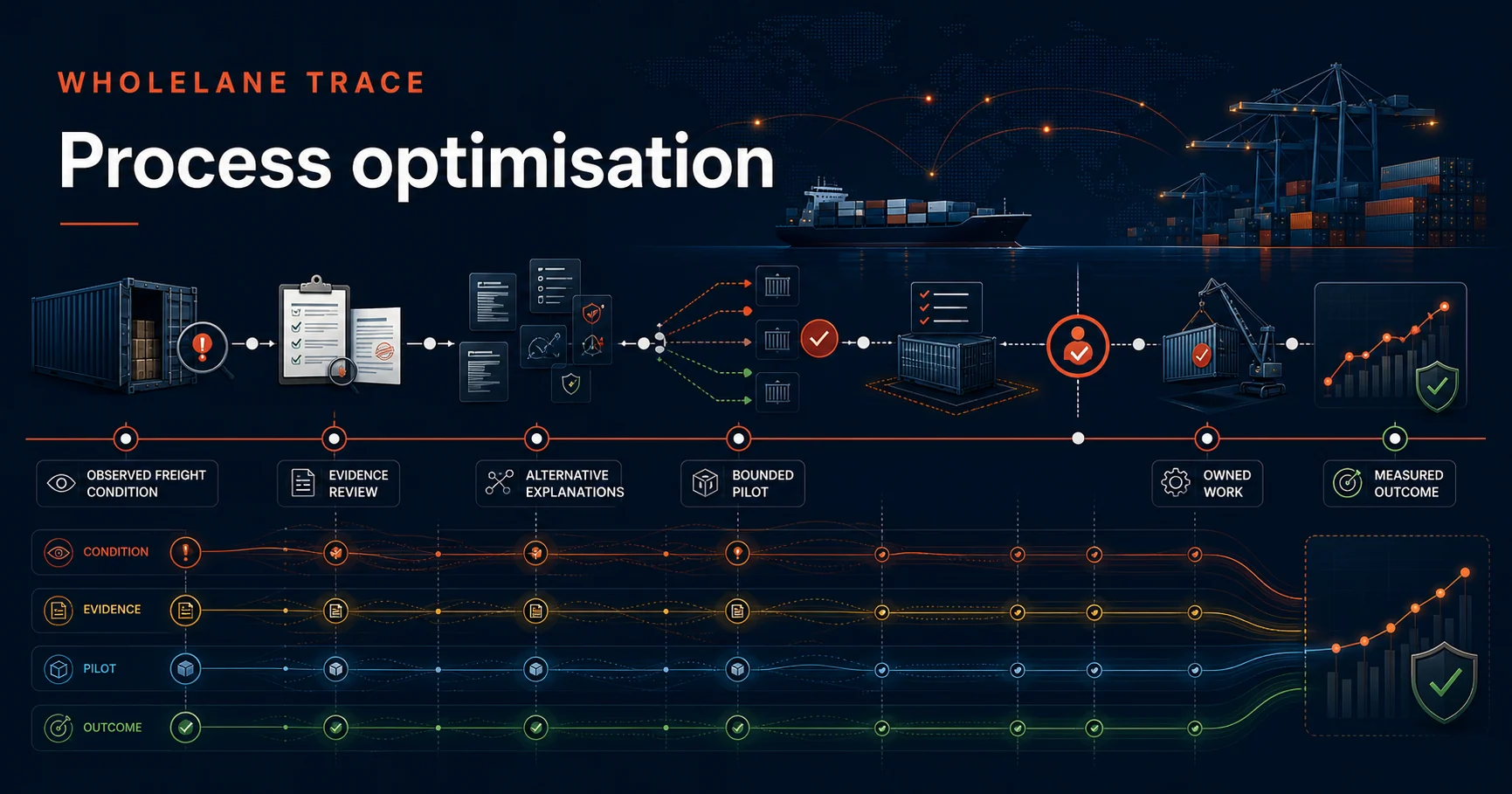
A practical classification helps teams select the right response. Trace uses patterns including control failure, flow delay, queue pressure, rework loop, handoff failure, variant leakage, outcome leakage and evidence failure.
The same headline measure can have different mechanisms. Late delivery evidence caused by an external carrier needs a different intervention from a document handoff that repeatedly returns to origin for correction.
Build a comparable reference cohort
Compare like with like. A useful cohort holds constant the relevant process profile and stage, approved local variant, mode, direction, service, special cargo, customer and lane complexity, and operating calendar.
When the cohort is too small or materially different, present it as context only. Do not promote an association to a causal claim merely because a chart moved.
Show evidence for and against the diagnosis
Tell the improvement case as an argument that another reviewer can challenge. Begin with the affected episodes and one representative freight journey, then connect the observed path to the supporting measures. Show the awkward evidence as well: comparable jobs that did not fail, plausible alternative explanations and any limitation in the source or mapping.
Finish by stating what new evidence would change the recommendation. That makes the proposal transparent and reviewable instead of presenting an opaque priority score as a decision.
Prioritise transparently
Trace combines material impact, recurrence, controllability, evidence confidence and guardrails. A mandatory control can override the normal ranking.
The point is not mathematical theatre. It is to let an authorised reviewer see why one opportunity should move before another and challenge any weak input.
Design a bounded pilot
A recommendation should name the proposed process change, responsible team and role, expected benefit range, risks, controls and approval path. The pilot needs:
- a defined intervention cohort;
- a credible control or baseline cohort;
- a release and start date;
- one primary success measure and relevant business outcome;
- guardrails that must not deteriorate;
- a review date and rollback condition.
Trace can assemble and track this improvement story. A person approves and implements it through the appropriate operating and source-system controls.
Measure the outcome without overselling it
An intervention may be effective, partially effective, ineffective, inconclusive, not implemented or rolled back. Report the decision with the observation window, cohort, intervention version and durability evidence.
A short-term improvement in the process measure is not enough if service, control, customer effort or financial outcome worsens elsewhere.
The authority boundary stays clear
Trace does not write booking, customs, transport or finance state to CargoWise. It does not change an SOP, bypass an approval or infer employee performance. It provides a data-led operating view, an explainable proposal and a controlled record of what happened next.
Trace supports this loop across the connected freight operation with approved rules, decision traces, role-controlled work orders and outcome feedback. Customer use requires verified source mapping, local approvals and deployment validation.
Next: Explore Trace Process Optimisation or start with the process-mining workspace.