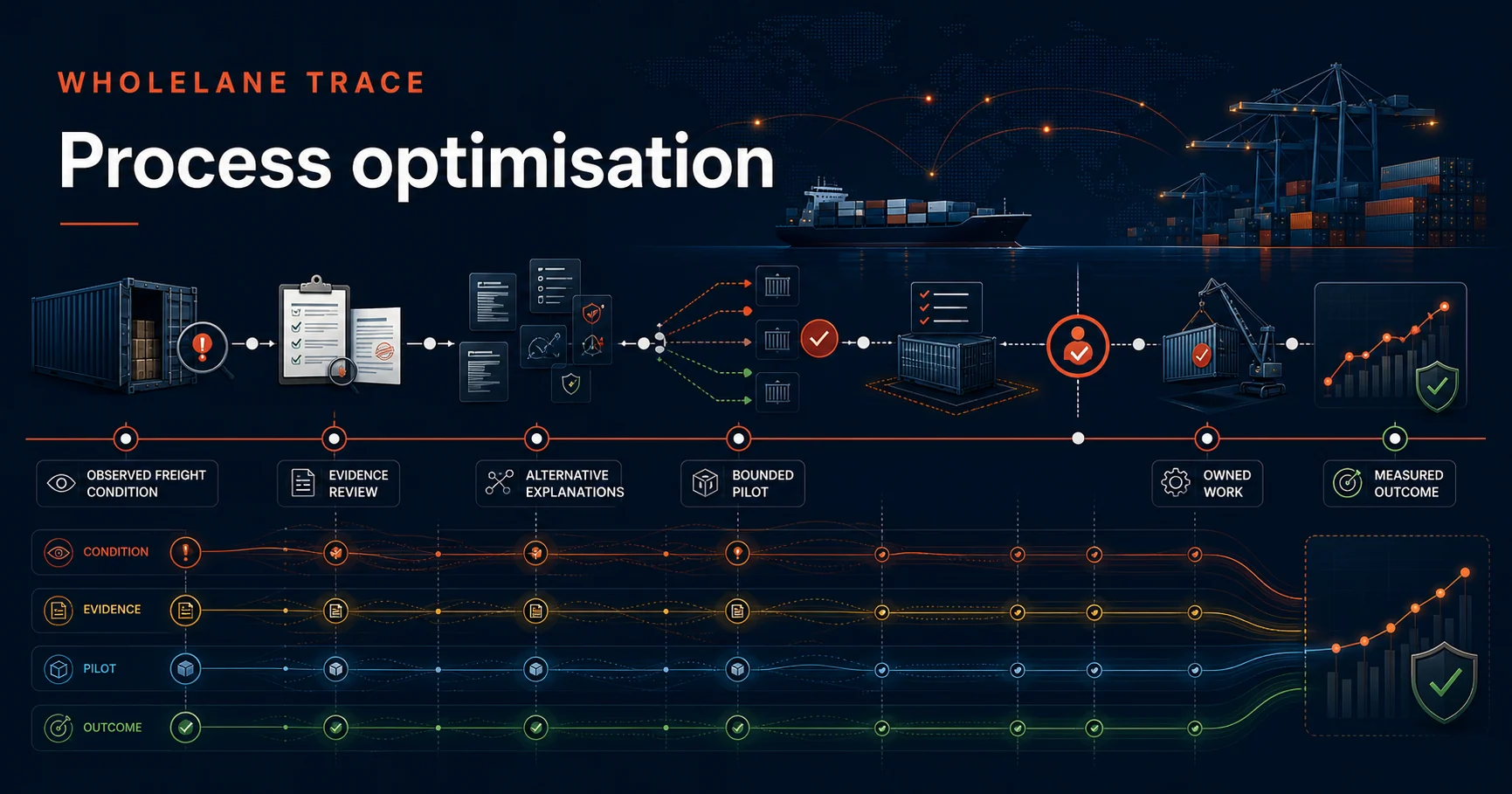
What the workspace is designed to answer
Process mining is useful when it answers a concrete operating question: what path did the freight work actually follow, where did it differ from approved intent and which source evidence supports that conclusion?
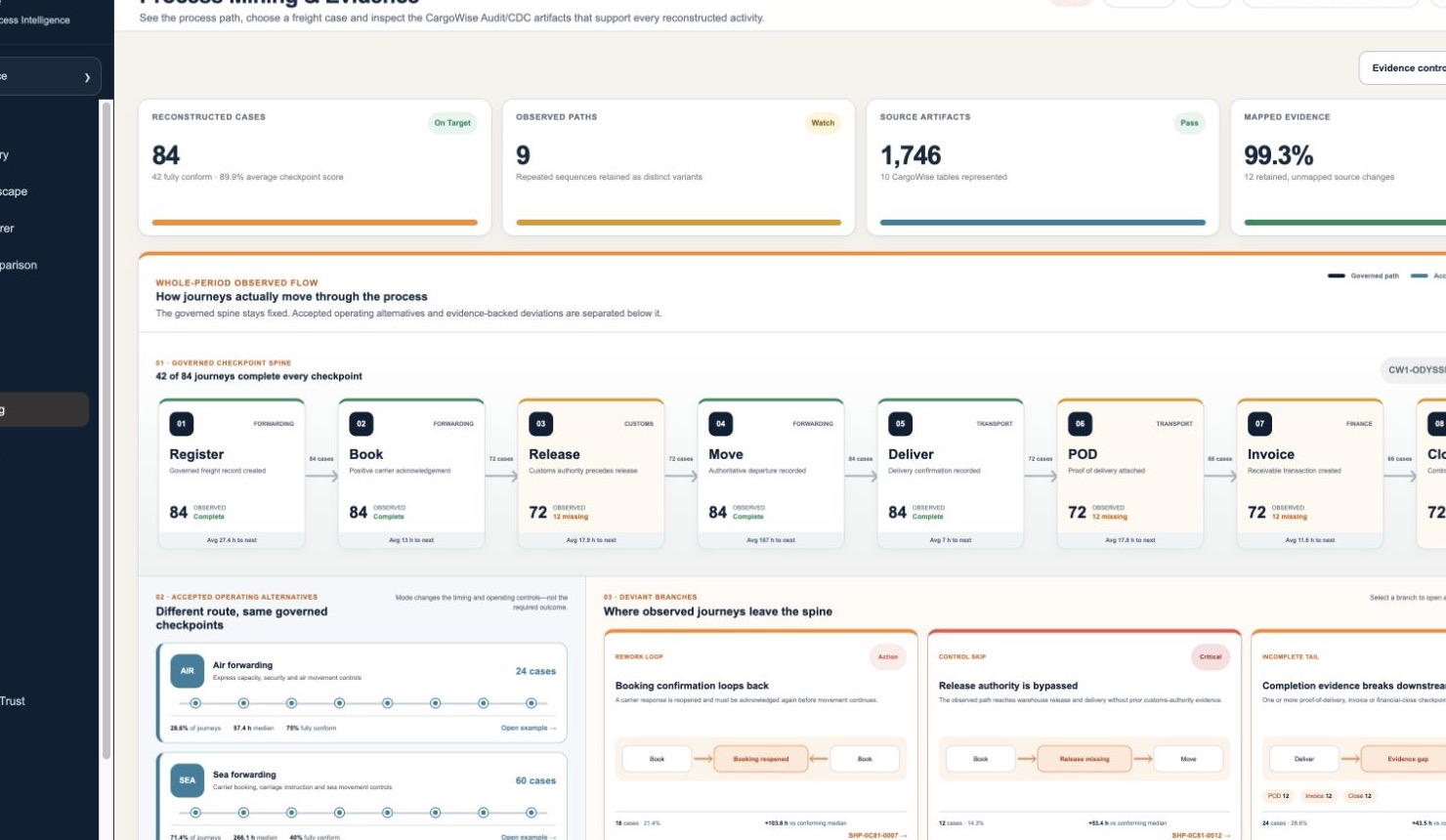
The Trace workspace keeps that question visible. It opens with reconstructed-case, observed-path, source-artifact and mapped-evidence coverage, then presents the observed flow as three distinct layers rather than one tangled diagram.
Step 1: accept and reconcile the source evidence
Trace begins with scheduled, read-only CargoWise audit and history extracts. The intake checks batch completeness, schema compatibility, object identity, continuity and source checkpoints before evidence can publish downstream.
Rejected or incomplete evidence remains visible in data trust. It does not quietly become a missing step or a healthy zero in the process map.
Step 2: reconstruct freight activities and cases
Technical field changes are not automatically business activities. Trace normalises timestamps and object relationships, suppresses duplicate and low-value noise, and maps material changes to canonical freight activities.
Those activities are assembled across the connected shipment, consolidation, declaration, transport, workflow, document and finance objects needed for the process question. The resulting case is a governed analytical unit, not a claim that one identifier represents the whole forwarding job.
Step 3: hold the governed process spine steady
The workspace uses eight checkpoints from registration through booking, release, movement, delivery, proof of delivery, invoicing and close. For each checkpoint it can show observed and missing cases, time to the next point and evidence state.
The spine is the approved comparison structure. Observed popularity does not rewrite it.
Step 4: separate valid alternatives from deviations
Air and Sea forwarding can follow different timing and operating paths while retaining the required controls. Trace therefore shows accepted mode alternatives separately from deviations.
The current reference evidence validates three useful deviation families:
- a booking rework loop;
- movement reached without the expected release evidence;
- an incomplete evidence tail before delivery, invoice or close.
Each branch reports the cases affected and provides a sample case for review. The purpose is not to label every uncommon path as wrong; it is to make the reason for the difference reviewable.
Step 5: drill into a case and its artifacts
A process map without evidence is only an illustration. Trace lets the reviewer move from a branch to an affected journey and then inspect the source artifacts supporting each reconstructed activity.
The drill-through preserves source table, artifact type, mapped activity and lineage. It also exposes retained but unmapped source changes so analysts can improve the mapping without disguising the gap.
How to review the workspace
Start with five questions:
- Is the evidence coverage sufficient for the period and process scope?
- Does the governed checkpoint spine match the approved procedure release?
- Are mode, service and local alternatives classified correctly?
- Can every material deviation be traced to affected cases and source artifacts?
- Does the condition recur in a comparable cohort strongly enough to justify an improvement review?
The fifth question is where process mining hands over to process optimisation. An observed branch is a signal, not yet a recommendation.
Customer validation boundary
Before customer use, the workspace requires verified source mapping, representative replay, approved local variants and agreement on process and control ownership. This keeps demonstration values separate from customer benchmarks and ensures the observed path reflects the operation being reviewed.
Next: Explore Trace Process Mining or see the controlled optimisation workflow.