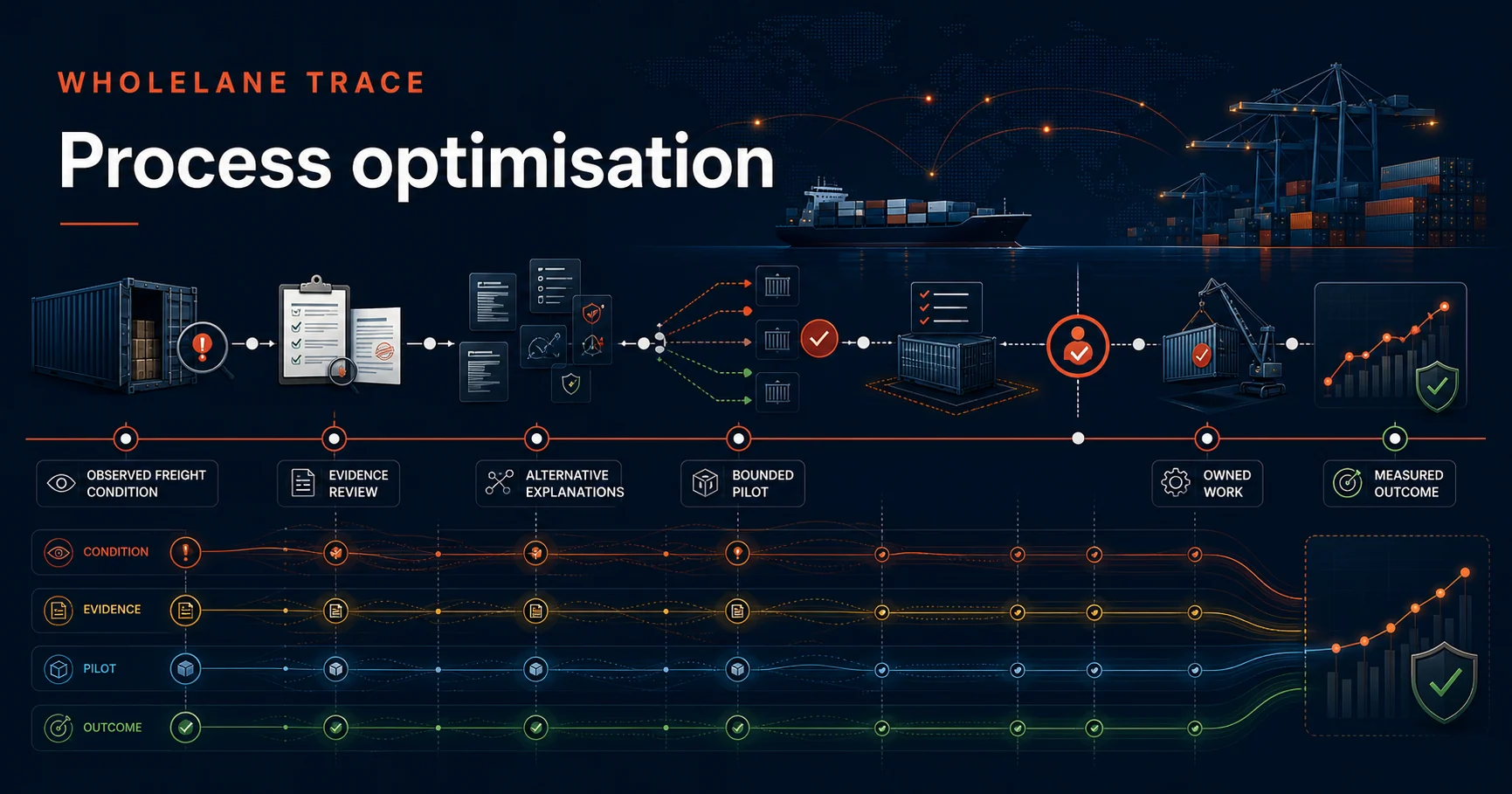
Operational completion is not financial completion
A shipment may be delivered while cost evidence, accrual, supplier invoice, customer billing, settlement, tax or margin review remains open. Treating operational close as financial truth hides exposure.
Expected cost before invoice
Every known third-party service should have a supplier, charge, basis, currency, expected amount, source and period. Accrual line coverage detects missing services; value coverage detects material under- or over-accrual.
Service events and financial outcomes
Imagine a booking rolling to a later vessel. The operational change may create extra handling, storage or transport cost, more customer communication and a revised delivery promise. If completion evidence then arrives late, customer billing waits; if supplier invoices arrive after the expected close, the reported margin changes again.
Connecting that history lets the business see how one service condition travelled into cost-to-serve, accrual completeness, invoice readiness and final margin. The same approach applies to document delays, customs holds, repeated rework and incorrect service classification: follow the event through to the customer and financial result rather than counting it in isolation.
Measures that should be related
Begin with stage dwell and exception duration, then follow any expedite or accessorial cost into accrual coverage and supplier matching. From there, measure invoice readiness, unbilled revenue, quoted-to-final margin variance and job-close lag. The sequence shows where operational friction becomes financial exposure and gives the responsible team a practical place to intervene.
Attribution must remain explicit
Carrier, customer, authority, internal process, system, data and force-majeure causes should be separated. A delayed close caused by supplier invoice timing is not the same as an internal accrual-control failure.
Action and outcome
A process or finance intervention should state the mechanism: earlier evidence request, expected-cost rule, billing gate, exception ownership or close policy. Remeasure both the process condition and financial result.